
By Dr. Anthony Cutting, DC
The Goal Is To Keep Playing With A Plan That Makes Sense
When a high school athlete starts hurting, the question is usually bigger than where the pain is: can they keep practicing, finish the season, or get back to the part of their sport they enjoy? A useful answer starts with the symptoms, the demands of the sport and an individual evaluation, rather than a promise that one treatment can keep every athlete injury-free.
I want to understand what you are trying to get back to. That is part of how I approach care at Active Chiropractic Meridian, whether the activity is a school sport, lifting weights or something much more ordinary.
For a parent, that conversation may begin with a detail that seems small. Your teenager stops taking the stairs normally. Throwing becomes uncomfortable. They keep sitting out the same drill. The useful question is what has changed and what needs to happen next.
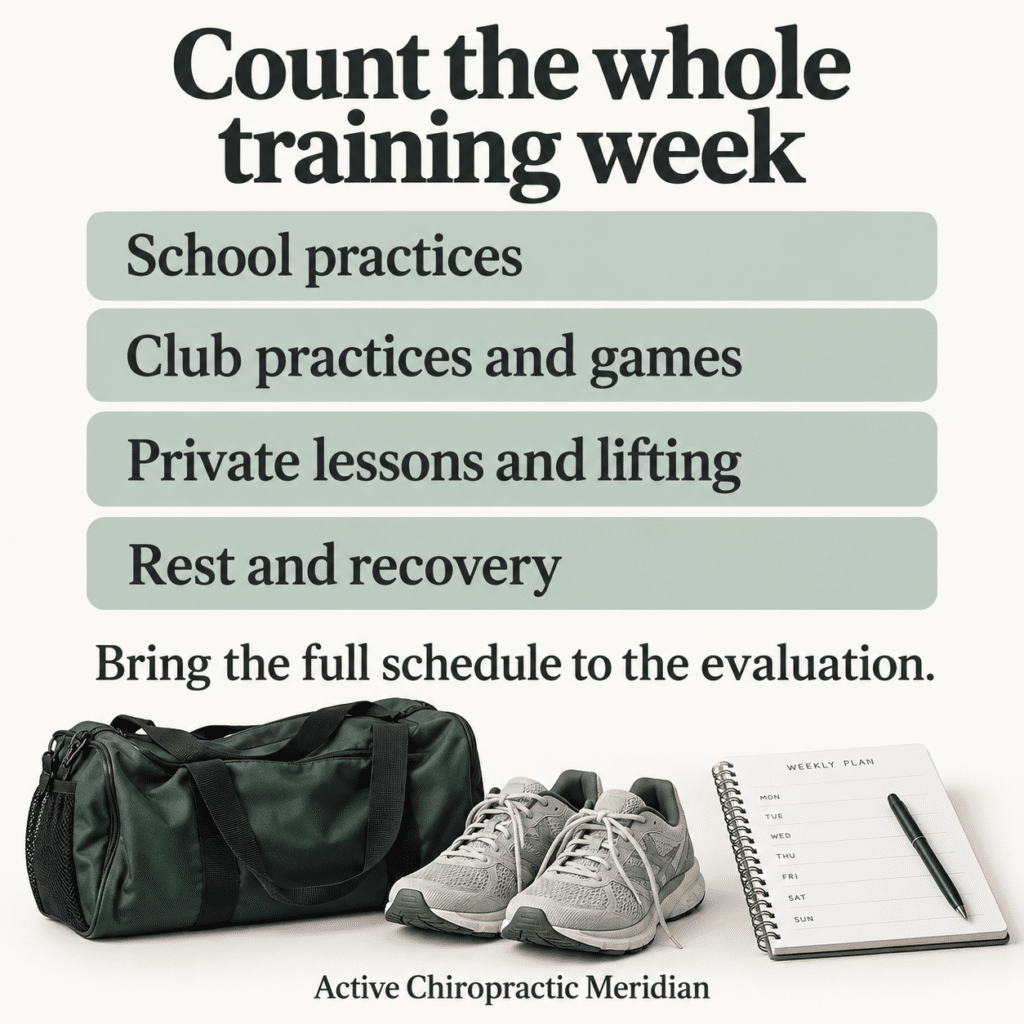
Count The Whole Training Week
A school coach may see the school practices. A club coach sees the club schedule. A private instructor sees one lesson. Your athlete’s body has to deal with all of it.
The American Academy of Pediatrics describes training load as the combined duration, intensity and type of activity. Overuse injuries can develop when those demands and the opportunity to recover are out of balance. That does not mean every busy athlete will be injured, or that a parent should be able to predict an injury before it happens. It means the full schedule belongs in the conversation. AAP guidance
Write down school practices, games, club sessions, private lessons and extra lifting. Include the days that are supposed to be easier. A day without a game may still involve several hours of organized training.
Bring that actual week to the evaluation. It is more useful than describing the athlete as simply busy, committed or out of shape. It also gives the family and coaches something specific to discuss if the plan needs to change.
Four details to bring to an athlete evaluation: onset, training changes, difficult movements and activity goals.
A Change In Function Deserves Attention
Pain is useful information, but so is what the athlete has started doing differently. The question is not only how much something hurts. It is whether the athlete can use the body part normally and whether symptoms keep returning with the same activity.
The American Academy of Orthopaedic Surgeons notes that overuse injuries in young athletes can involve growing bone as well as tendons and other tissues. Repeated pain should not automatically be dismissed as growing pains or ordinary soreness. Persistent symptoms need appropriate medical evaluation. AAOS guidance
Useful observations to share include:
- The movement that brings symptoms on
- Whether the problem starts during activity or afterward
- Swelling, a limp or difficulty using the limb
- An activity the athlete has stopped doing normally
- Whether the same problem returns after a break
Those observations help explain the problem. They do not establish a diagnosis from home. A parent should not have to decide whether a painful knee is a tendon problem, a bone injury or something else before asking for help.
A Quiet Weekend Does Not Answer Every Question
A break can change how an athlete feels, but improvement during rest does not necessarily explain why the problem occurred. If symptoms return when the same activity resumes, that response is worth reporting.
Think of a teenager who feels comfortable during an easier weekend but struggles again during the first full practice. That is an example of a useful history detail, not proof of a particular injury. What changed between those two situations? Was it the duration, the movement, the speed or the amount of resistance?
I use information about what someone has already tried to help understand the next step. Rest, previous treatment and the response to returning to an activity should be part of the discussion, rather than treated as irrelevant because the symptoms are still there.
An Evaluation Should Explain The Next Step
At Active Chiropractic Meridian, the first visit begins with a conversation about your history, goals and previous care. Recommendations follow the individual evaluation.
For an athlete, a useful explanation should connect the findings to the activity that has become difficult. What is the working diagnosis? Is more information needed? Is conservative care reasonable, or does the athlete need another provider? What should happen with the activity while that question is being resolved?
The plan should also make sense to the athlete. A teenager who understands what the recommendation is for has more to work with than a list of things they have been told to stop doing.
Bring relevant medical notes, imaging reports and any instructions already provided by a physician or athletic trainer. The next appointment should build on that information.
Screening Is Information, Not An Injury Forecast
An examination can identify current symptoms, movement limitations and questions worth investigating. It cannot promise that a particular athlete will avoid an ACL tear, a fracture or another future injury.
There is a difference between explaining what a person can currently do and claiming to know what would have happened without treatment. Families deserve that distinction. A finding should be explained in the context of the athlete’s history and symptoms, not used to suggest that a serious injury is inevitable unless they begin care.
The same principle applies to an athlete who feels well. A visit should have a clear purpose. No screening result makes sport risk-free, and no blanket visit schedule is the right answer for every teenager.
Recovery Belongs In The Schedule Too
The AAP recommends regular time away from organized sport, including one to two days off each week and time away from each specific sport during the year. It also emphasizes adequate nutrition, sleep and gradual changes in training. These are general prevention recommendations, not an individualized rehabilitation plan for an injured athlete. AAP recommendations
For families, the practical starting point is to make recovery visible on the calendar. Who knows about the second team? Is the weekend tournament being considered when the next week’s schedule is planned? Does the athlete have room to say that something hurts without feeling that they have let everyone down?
That conversation does not require a dramatic intervention. It requires the adults involved to be working from the same information. If an injury has already occurred, follow the treating provider’s recommendations rather than using a general schedule as permission to resume sport.
What Conservative Care May Include
Depending on the working diagnosis and individual evaluation, care at Active Chiropractic Meridian may include chiropractic care, soft-tissue treatment, rehabilitation or movement-based care. The office also offers Shockwave Therapy and Class IV Laser, but the availability of a service does not make it appropriate for every injury or every age.
This article is not a recommendation for those treatments in a growing athlete. Suitability depends on the diagnosis, age, treatment area and relevant precautions. A sports injury is not one condition with one standard treatment package.
My goal is to give clear recommendations and honest expectations. If another provider is the more appropriate next step, I will recommend that. You can read more about our general approach on the chiropractic services page.
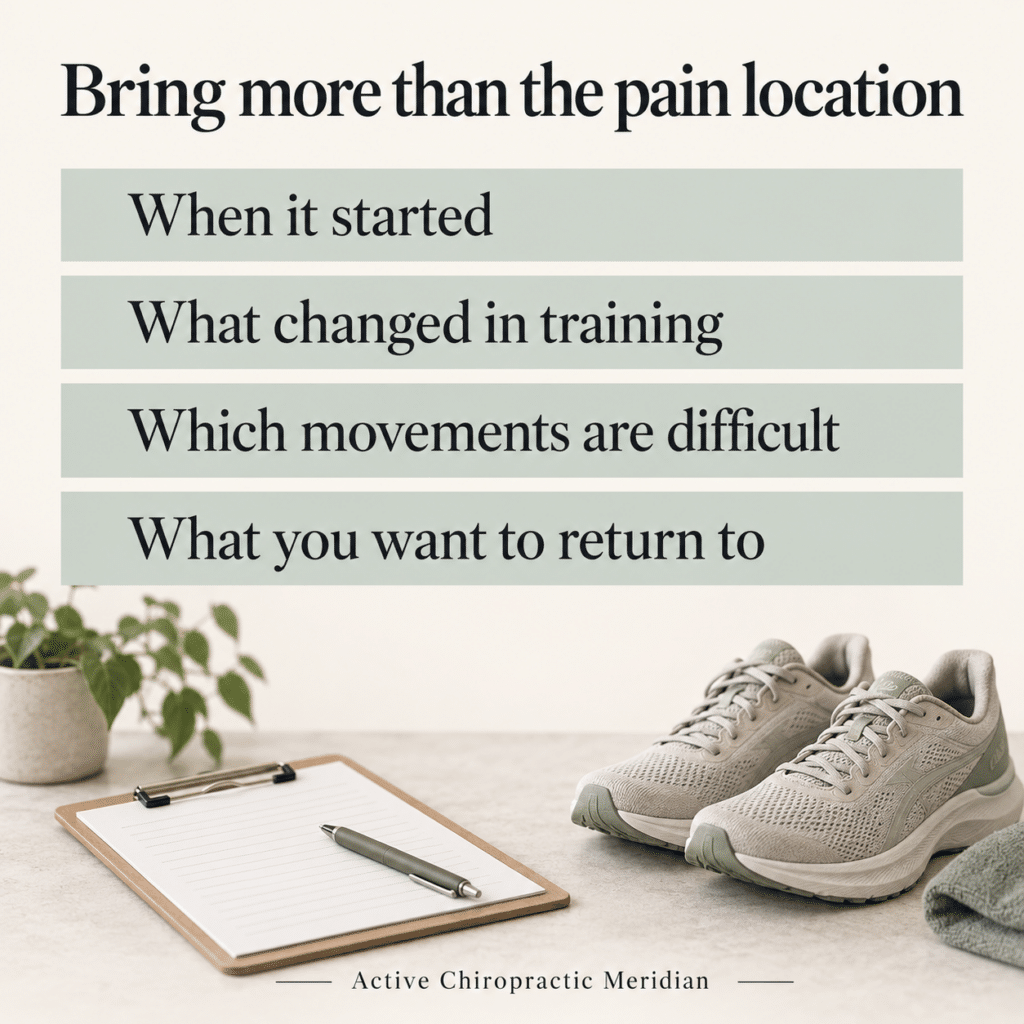
Four details to bring to an athlete evaluation: onset, training changes, difficult movements and activity goals.
Make The Follow-Up Question Specific
Before leaving an evaluation, make sure you understand what is being reassessed and what information would change the plan. That may include a particular movement, an everyday activity or a symptom that should prompt earlier contact.
Being more comfortable is valuable. The athlete and family also need to understand what that change means for the activity they want to resume. A pain score alone is not a complete return-to-sport decision.
Questions worth asking include: What activities are appropriate now? What should we avoid until the next review? Who should communicate with the coach or athletic trainer? When should we contact the provider sooner?
Those answers should come from the person managing the injury, with the school’s participation requirements taken into account. They should not be improvised on the sideline because an important game is coming up.
When The Athlete Needs Prompt Medical Attention
A new injury with an obvious deformity, inability to bear weight or use the limb, severe pain or substantial swelling needs prompt medical assessment. AAOS explains that growth-plate injuries can require urgent attention and should not be treated as a routine training complaint. Growth plate fractures
If a hit, fall or collision raises concern for concussion, remove the athlete from play and seek medical evaluation. They should not return that day. Emergency warning signs after a head injury include a worsening headache, repeated vomiting, seizures, increasing confusion, slurred speech, weakness or difficulty waking. Call 911 or go to an emergency department for danger signs. CDC concussion guidance
For a separate discussion of symptoms that continue after a concussion, read our concussion symptoms and follow-up guide.
Start With The Activity Your Athlete Wants Back
The useful starting point is a clear account of what has changed. Which activity matters to your athlete? What have they tried? What do they need explained before the next decision?
If musculoskeletal pain is affecting your teenager’s activity, call 208-593-2001 to ask whether an evaluation at Active Chiropractic Meridian in Meridian, Idaho may be appropriate. Bring the training schedule and any previous instructions. I would rather understand the full situation than start with a treatment before we have discussed the problem.
Read about sports injury care for high school athletes in Meridian for appointment information.
FAQs
Should my teenager play through pain if they can still finish practice?
Finishing practice does not establish that an injury is minor. Repeated pain, swelling, a limp or a change in how the athlete uses a limb deserves attention. Tell the coach or athletic trainer and arrange appropriate evaluation, especially when symptoms persist or return. Severe symptoms or a suspected head injury need more immediate medical attention.
Is a sports injury evaluation the same as a school sports physical?
No. A preparticipation sports physical addresses readiness for participation and the school’s requirements. An injury evaluation addresses a particular problem. One should not be assumed to replace the other. Check the school’s requirements and ask the office what appointment is appropriate; this article does not advertise sports-physical or clearance services.
Should every high school athlete have monthly chiropractic visits?
No single visit schedule fits every athlete. The reason for care, examination findings, goals and response should guide recommendations. At Active Chiropractic Meridian, the plan is individualized. Families should understand what each visit is intended to assess or address and when the plan will be reviewed.
What should we bring if the athlete has already seen another provider?
Bring relevant reports, treatment notes, activity restrictions and instructions from the provider or athletic trainer. Include the full practice and competition schedule and a description of what changed with previous care. This information helps the next evaluation build on the work already done.
About Dr. Anthony Cutting

Dr. Anthony Cutting owns and provides care at Active Chiropractic Meridian in Meridian, Idaho. His approach emphasizes listening, clear explanations, individualized recommendations and the function each patient wants to regain. Depending on the diagnosis and evaluation, care may include chiropractic care, soft-tissue treatment, rehabilitation and movement-based care. He recommends another provider when that is the more appropriate next step.
Sources
- American Academy of Pediatrics: Preventing Overuse Injuries in Young Athletes
- American Academy of Orthopaedic Surgeons: Overuse Injuries in Children
- American Academy of Orthopaedic Surgeons: Growth Plate Fractures
- CDC HEADS UP: Responding to a Sports-related Concussion
This article provides general education and does not replace an individual medical evaluation.