
It Got Better. So Why Does Shoulder Pain Keep Coming Back?
This is the frustrating part. You did something about it. Maybe you rested it, went through physical therapy, had an injection, got massage, changed your workouts, or saw another chiropractor. It improved enough that you started trusting the shoulder again.
Then it came back.
I see this a lot, and I do not start by assuming the previous care was wrong. Shoulder pain can be surprisingly deceptive. Two people can point to the exact same spot and be dealing with different problems. Two people can even have the same diagnosis and need different plans because their motion, strength, history, activity demands and goals are different.
So the question I care about is not just, “Why does it hurt again?”
It is, “What does this shoulder still need us to understand?”
Maybe you want to sleep on that side without waking up. Maybe you want to press overhead again, finish 18 holes, play pickleball, lift your grandchild, work with your arm above your head, or throw a football with your son. That goal tells me a lot more than a pain score by itself.
The Pain Location Is Only Part Of The Story
“My shoulder hurts right here” is useful information. It just is not the whole answer.
Frozen shoulder, rotator cuff problems, arthritis and pain referred from the neck can overlap more than most people expect. That is why I look for patterns instead of trying to name the problem from one painful spot.
A few examples:
- Frozen shoulder often develops gradually and brings significant stiffness. Both active motion, what you can move yourself, and passive motion, what I can move for you during an examination, are usually limited.
- Rotator cuff problems may show up more as pain or weakness with specific movements, especially lifting, reaching or working overhead. Strength testing matters here.
- Shoulder arthritis can cause aching, stiffness and a gradual loss of motion.
- Pain coming from the neck may travel into the shoulder or arm and can come with numbness, tingling or weakness.
Those patterns help me build a working diagnosis. They are not a home diagnostic test, and one symptom by itself is not enough to tell you which problem you have.
I Want To See What The Shoulder Can Actually Do
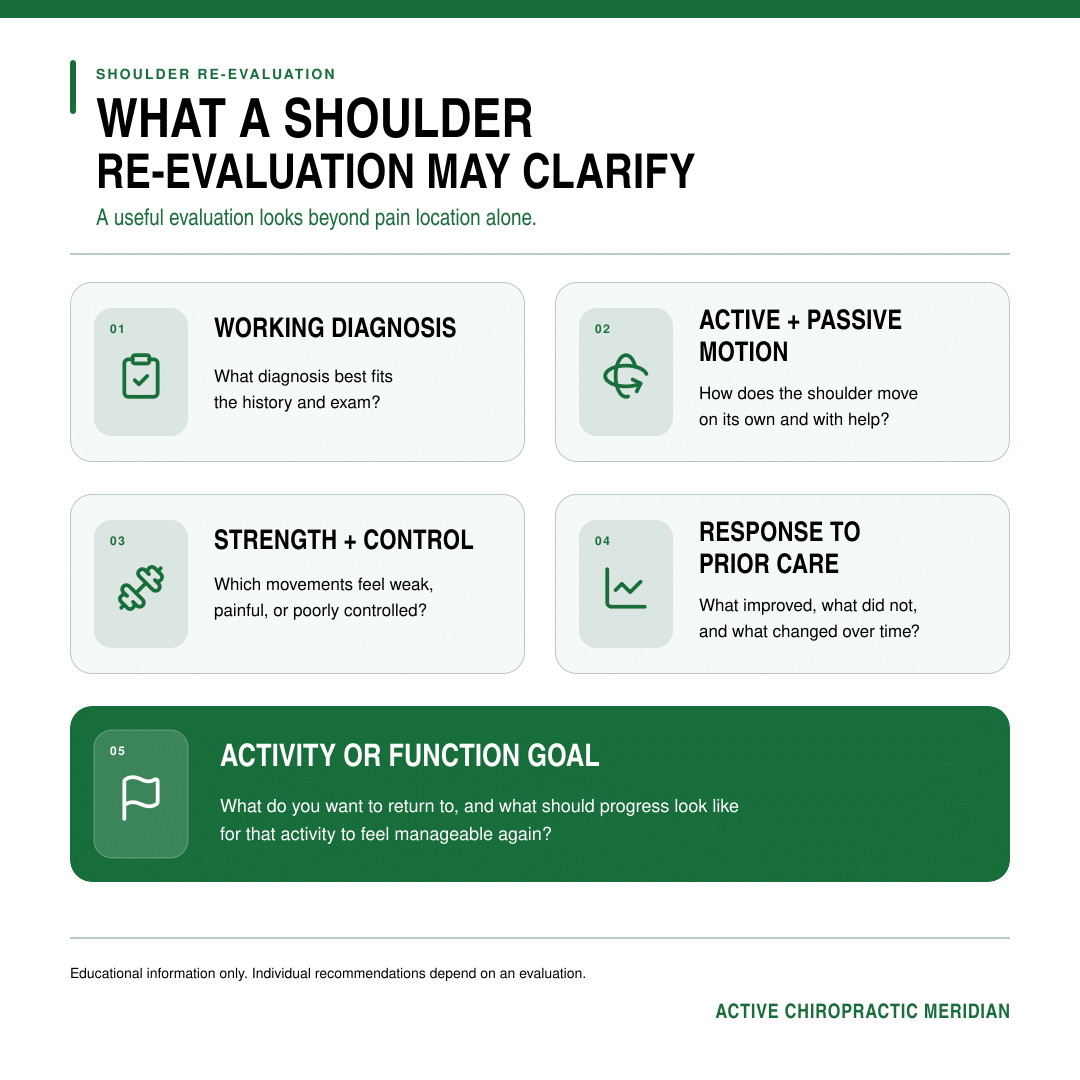
Pain tells me something. Motion and strength tell me more.
For frozen shoulder, the American Academy of Orthopaedic Surgeons notes that both active and passive range of motion are limited. For suspected rotator cuff tears, the 2025 AAOS guideline supports using a combination of clinical examination tests rather than relying on one test by itself.
So I may compare how far you can move the arm on your own with how far it moves when I guide it. I may test strength, reproduce certain movements, check relevant neck findings, review prior injuries, and look at the exact task that keeps giving you trouble.
That is where the shoulder starts telling a more useful story.
A Shoulder At Rest And A Shoulder In Real Life Are Two Different Tests
A shoulder can feel pretty good when you stop asking much of it.
The more useful question is what happens when normal life comes back.
Does it flare when you reach into a high cabinet? After nine holes of golf? During a bench press or pull-up? When you sleep on that side for a few hours? When you go back to lifting at work?
That pattern matters. It helps me understand what the shoulder currently tolerates and what may need to be rebuilt before you can ask more of it again.
My goal is not to make you afraid of using your shoulder. It is to help you understand what it is ready for now and what it may need before you return to the activity you care about.
What You Tried Before Is Not Wasted Information
A lot of the shoulder patients I meet have already done something. Physical therapy. Massage. An injection. Home exercises. Rest. Another chiropractic office.
I do not look at that history and think, “None of it worked. Start over.”
I want to know exactly what happened.
- What got better?
- What never changed?
- Did your motion improve but your strength stay limited?
- Did you feel good until one particular activity came back?
- Was the original working diagnosis ever revisited?
- Is the shoulder behaving differently now than it did six months ago?
Your response to previous care is part of the evaluation. Sometimes it points toward a different conservative plan. Sometimes it tells me imaging, another clinician or an orthopedic evaluation belongs in the conversation.
Jeremy Had Been Dealing With His Shoulder For A Long Time
Jeremy G. came to our office after a serious scooter accident and described months of very limited ability to lift his arms. His experience is one patient’s story, not a prediction of what another shoulder will do, but it captures something I hear often from people who have been dealing with the same problem for a long time. In his words:
“When I first saw Dr. Cutting, I had been in a really bad scooter accident. For about six months, I could barely lift my arms. A year went by and I met Dr. Cutting, and honestly I was thinking, what can a chiropractor do when it has been hurting this long? We worked with the laser, Shockwave Therapy and his adjustments, and I started to have more mobility in my arm. It feels as close to 100% as it has felt since before the accident. I’ve been to chiropractors before, but I’ve never had one look at everything the way he does. It doesn’t feel like one-size-fits-all treatment. When I come in, it feels like he’s looking at what I need.”
Publication note: This is Jeremy’s individual experience. It does not establish what another patient should expect, and outcomes depend on the diagnosis, health history, severity of the problem and response to care. Confirm written authorization before publishing his name or testimonial.
Do You Need An MRI Because The Pain Came Back?
Maybe. But not automatically.
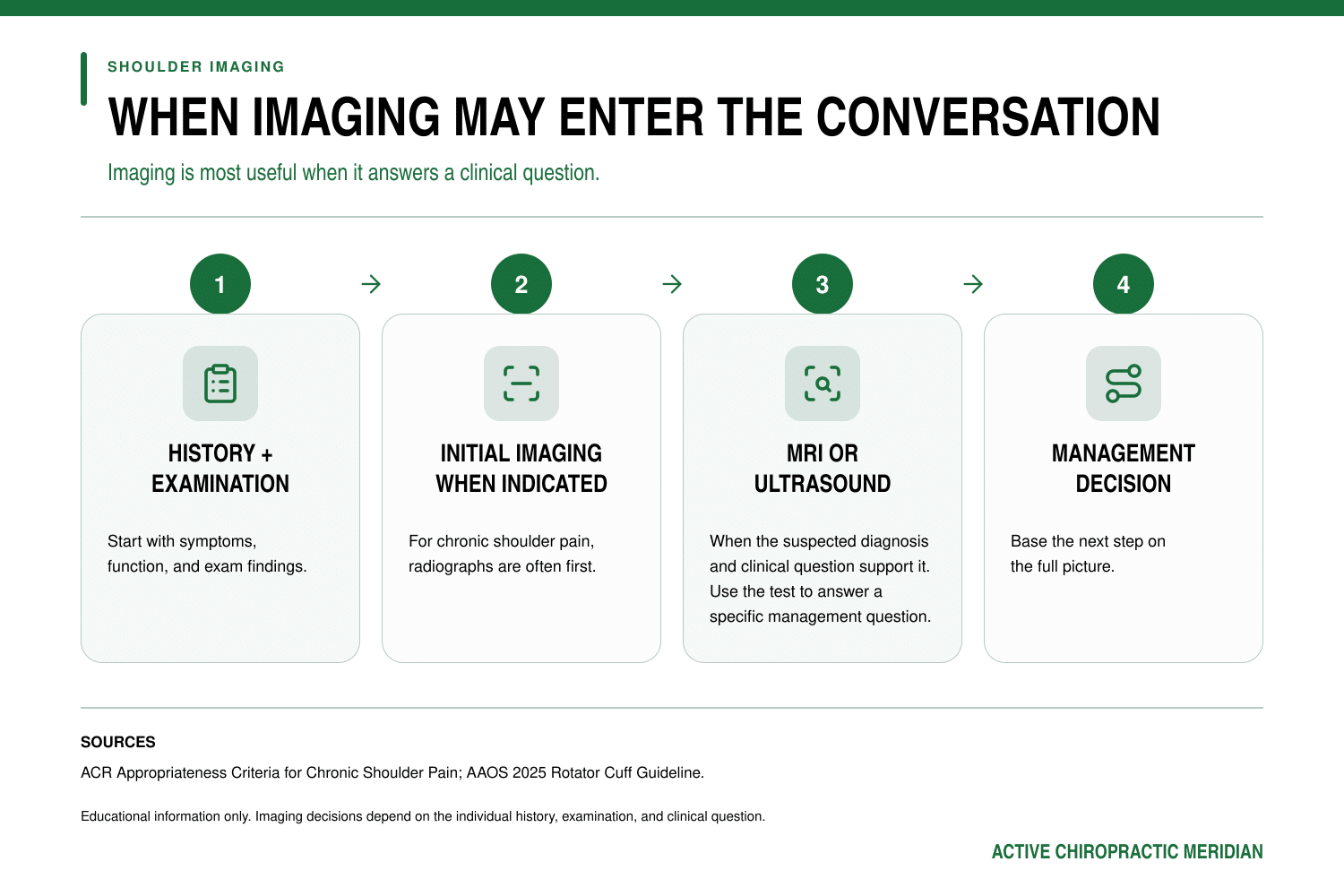
Imaging is useful when it answers a question we actually need answered.
For chronic shoulder pain, the American College of Radiology rates shoulder X-rays as the usual initial imaging study. If the history and examination point toward a rotator cuff problem and those X-rays are normal or inconclusive, ultrasound or MRI without contrast are among the studies commonly considered next. The 2025 AAOS rotator cuff guideline also describes MRI and ultrasound as useful additions to the clinical examination and radiographs when a tear is being evaluated.
So I do not order the story backward. I do not want the MRI to tell me what to look for. I want the history and examination to tell me what question the imaging needs to answer.
If Your MRI Says "Rotator Cuff Tear," Do Not Stop Reading There
A tear matters. It just does not make the entire decision by itself.
The 2025 AAOS guideline reports that both physical therapy and surgery can improve patient-reported outcomes for symptomatic small to medium full-thickness rotator cuff tears. It also notes that people with symptomatic full-thickness tears can improve with physical therapy, while tear size and muscle changes may progress over longer-term nonoperative management.
That is why I want to know more than the word “tear.” How large is it? How did it happen? How much strength have you lost? What can you still do? What are you trying to get back to? What has already been tried?
Sometimes conservative care is a reasonable option. Sometimes an orthopedic or surgical evaluation is the better next step. I am not trying to keep every patient out of surgery. I am trying to help the right patient make the right next decision.
What I Want To Know Before I Recommend Anything
The treatment should follow the evaluation, not the other way around.
If I believe conservative care is appropriate, a plan may include rehabilitation and movement-based care, chiropractic care, soft-tissue treatment, or other services available in our office. Shockwave Therapy or Class IV Laser may be considered for some diagnoses, but I do not treat either one as the automatic answer for every painful shoulder.
And I am not only watching the pain number.
Can you reach farther? Sleep more comfortably? Control the arm better? Tolerate more activity? Get through a workout, workday or round of golf with fewer limitations?
That is the kind of progress I want to measure because that is the reason you came in.
When Shoulder Pain Needs More Than A Routine Office Visit
Recurring pain is different from an acute emergency.
Seek urgent medical care after an injury if the shoulder looks deformed, you cannot use the shoulder or move the arm away from the body, pain is intense, or swelling is sudden. Shoulder pain accompanied by chest tightness, trouble breathing or sweating can be a medical emergency and should not be treated as a routine musculoskeletal complaint.
The Question I Would Ask Next
If your shoulder keeps coming back, I would not make the next question, “What treatment should I try now?”
I would make it, “What do we still need to understand before we choose the next step?”
That may mean clarifying the working diagnosis, looking at strength and motion again, reviewing what happened with previous care, or deciding whether imaging or another provider belongs in the picture.
If recurring shoulder pain is keeping you from sleeping, lifting, working, golfing, training or using your arm normally, call 208-593-2001 to schedule an evaluation with me at Active Chiropractic Meridian. If you have imaging or notes from previous treatment, bring them. I would rather start with what you already know than pretend we are starting from zero.
FAQs
Does shoulder pain coming back mean the previous treatment failed?
Not necessarily. A recurrence may mean the shoulder needs to be reassessed as activity changes, the working diagnosis needs to be revisited, or there are still functional limits that matter. When I evaluate recurring shoulder pain, I use the response to previous treatment as information about what to examine next.
Do I need an MRI because my shoulder pain keeps returning?
Not automatically. For chronic shoulder pain, radiographs are commonly the initial imaging study. MRI or ultrasound may be appropriate when the history and examination suggest a rotator cuff problem or another soft-tissue condition and the result would help guide management. I want imaging to answer a useful clinical question, not simply be ordered because the pain returned.
Does a rotator cuff tear on an MRI always mean I need surgery?
Not necessarily. The right next step depends on the type and severity of the tear, your symptoms, strength, function, activity goals, health history, and how you have responded to previous care. Current AAOS guidance indicates that both physical therapy and surgery can improve outcomes for some people with symptomatic small to medium full-thickness rotator cuff tears. I look at the MRI as one part of the picture, rather than letting the imaging result make the entire decision.
What should I bring to a shoulder evaluation?
Bring relevant imaging reports, information about previous treatment and a clear description of the movements or activities that bring the symptoms back. I also want to know the function you most want to regain, whether that is sleeping comfortably, lifting, working, golfing or returning to another activity.

About Dr. Anthony Cutting
Dr. Anthony Cutting owns and provides care at Active Chiropractic Meridian in Meridian, Idaho. He evaluates musculoskeletal concerns with an emphasis on clear explanations, individualized recommendations, realistic expectations and the function each patient wants to regain. Depending on the working diagnosis and individual evaluation, care may include chiropractic care, rehabilitation and movement-based care, soft-tissue treatment, Shockwave Therapy or Class IV Laser. When another provider or surgical evaluation is the more appropriate next step, he recommends it.
Sources
- American Academy of Orthopaedic Surgeons, Management of Rotator Cuff Injuries: Evidence-Based Clinical Practice Guideline, published August 18, 2025
- American College of Radiology, ACR Appropriateness Criteria: Chronic Shoulder Pain, revised 2022
- American Academy of Orthopaedic Surgeons, Frozen Shoulder
- Mayo Clinic, Shoulder pain: When to see a doctor