
By Dr. Anthony Cutting, DC
The Next Step Should Explain More Than How Long To Wait
If headaches, dizziness, brain fog or other symptoms continue after a concussion, the next step is follow-up with the healthcare provider managing the injury. A useful review considers what is improving, what still limits school or daily life, and whether the recovery plan or referral needs to change.
The question may sound simple: when can my teenager get back to normal? But normal includes more than playing in the next game. It includes reading an assignment, getting through the school day, sleeping and spending time with friends.
My approach to care starts with understanding the function someone wants to regain and giving honest recommendations. With concussion, that also means being clear about the limits of a general article and the importance of appropriate medical care. This is education for families, not a diagnosis or permission to return to sport.

Dr. Anthony Cutting, owner of Active Chiropractic Meridian.
Some Symptoms Should Not Wait For A Follow-Up Appointment
After a head injury, call 911 or go to an emergency department for danger signs such as a worsening headache that does not go away, repeated vomiting, seizures, increasing confusion, slurred speech, weakness, unequal pupils or difficulty waking. These can indicate a more serious injury. Do not use a routine chiropractic appointment as the next step when emergency assessment is needed. CDC signs and symptoms
A suspected concussion also requires removal from sport and medical assessment. An athlete should not return to play on the day of the injury, even if they begin to feel better. The person on the sideline should not have to decide how serious the injury is before taking it seriously. CDC response guidance
If the injury has already been assessed, follow the instructions you were given and contact the treating provider about symptoms that worsen or do not resolve. New concerns should not be ignored because the first appointment was reassuring.
Persistent Symptoms Need An Individual Review
Recovery varies. CDC guidance says many children improve within two to four weeks, while symptoms continuing beyond that period may call for specialist referral. That is a reason to review the plan, not a deadline your child has failed to meet. CDC recovery guidance
The international Amsterdam concussion consensus describes symptoms lasting longer than four weeks as persisting symptoms. It recommends assessment that considers the different factors that may be contributing. Symptoms may involve several areas, including headache, sleep, mood, balance, vision or the neck, and they are not specific to one explanation. Amsterdam consensus
For the family, a helpful preparation is to describe what is happening during an ordinary day. Is reading difficult? Does the headache change during school? Is dizziness limiting movement? What has improved since the last appointment?
You do not need to decide which body system is responsible. That is what the assessment is for. Avoid turning a list of possible contributors into a self-diagnosis or assuming one finding explains every symptom.
The School Day Belongs In The Recovery Plan
Return to school and return to competitive sport are related decisions, but they are not identical. A student may need temporary support with school demands while recovery continues.
CDC recommends coordination among the healthcare provider, family and school. Depending on symptoms, support may include breaks, adjustments to assignments or help managing a busy classroom environment. Many students can return to school within one to two days after a concussion, even while some symptoms remain, with appropriate support. The plan should respond to the individual student. CDC school guidance
Make it easy for the school to understand what is difficult. A student saying they feel off is different from explaining that reading becomes harder after a particular amount of time or that a noisy classroom increases symptoms.
Ask who will collect those observations and communicate changes. A plan works better when the family knows which teacher, nurse, counselor or other staff member is helping coordinate it.
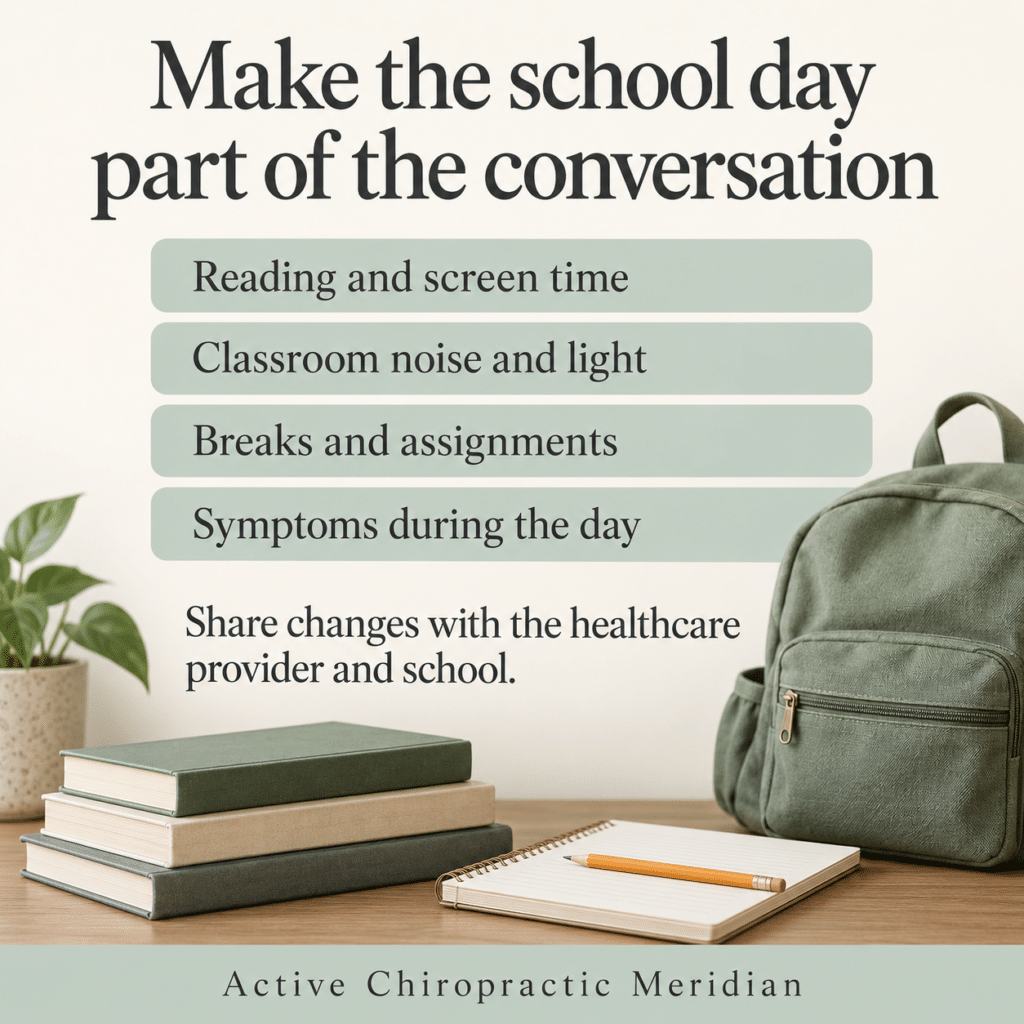
School-day observations to discuss during concussion recovery: reading, light and noise, breaks and symptoms.
The Follow-Up Questions I Would Want A Family To Have Answered
The purpose of the next appointment is to make the next decision clearer. You should leave knowing what the current plan is trying to accomplish, what needs monitoring and who to contact if the situation changes.
| Question | What the answer should clarify |
|---|---|
| What is improving, and what still limits the day? | The symptoms and activities that need continued attention. |
| Does the assessment suggest another contributor? | Whether additional evaluation or a referral would be useful. |
| What activity is appropriate now? | The treating provider’s current guidance, including school and sport restrictions. |
| When should we contact you sooner? | Changes that need earlier advice or urgent medical attention. |
These questions are a way to organize a conversation. They are not a scoring system for deciding whether someone is recovered.
Neck Symptoms Can Matter Without Explaining Everything
Neck pain, dizziness and headaches can be part of a complicated symptom picture after an injury. The Amsterdam consensus supports targeted rehabilitation for particular findings, including cervical and vestibular concerns. Vestibular refers to systems involved in balance and the sense of movement. Amsterdam consensus
That does not mean every lingering concussion symptom comes from the neck, or that evidence for a rehabilitation program establishes that a particular adjustment or treatment device heals a concussion. The evaluation needs to determine which findings are relevant and which professional should address them.
If a family seeks help for a musculoskeletal concern while concussion symptoms are present, share the injury history and the medical plan. Care for an accompanying concern should fit with that plan. An improvement in neck comfort should not be used as permission to resume contact sport.
Activity Returns In Stages, Not According To The Next Game
Prolonged complete inactivity and isolation in a dark room are not the default recovery approach. CDC guidance describes a brief initial period of rest followed by a gradual return to suitable activities under the healthcare provider’s guidance. The appropriate amount depends on symptoms and the medical plan. CDC recovery guidance
Return to sport requires healthcare-provider approval and supervision. CDC’s progression moves from regular activities through increasing exercise demands, then appropriate practice and competition. Each step typically takes at least 24 hours. New or returning symptoms mean the athlete should stop that activity and contact the provider for guidance. CDC return-to-sports progression
This is not a countdown that guarantees readiness in a week. School requirements and the treating provider’s instructions still apply. The decision should not depend on how important the next game is or whether an athlete feels pressure to avoid disappointing the team.
Be Clear About What A Treatment Is Intended To Do
A treatment recommendation should name the problem it is addressing, explain why it may be appropriate and describe how progress will be reviewed. A promise to correct a hidden imbalance is not a substitute for that explanation.
Active Chiropractic Meridian offers individualized musculoskeletal care. Chiropractic care should not be presented as a treatment that heals the brain injury or guarantees a concussion recovery timeline. Ask the healthcare provider managing the concussion about appropriate testing, referrals and clearance requirements.
The concussion-managing provider should guide the injury’s medical care and appropriate referrals. For questions about the practice’s general services, the Active Chiropractic Meridian services page explains what is available, with suitability determined individually.
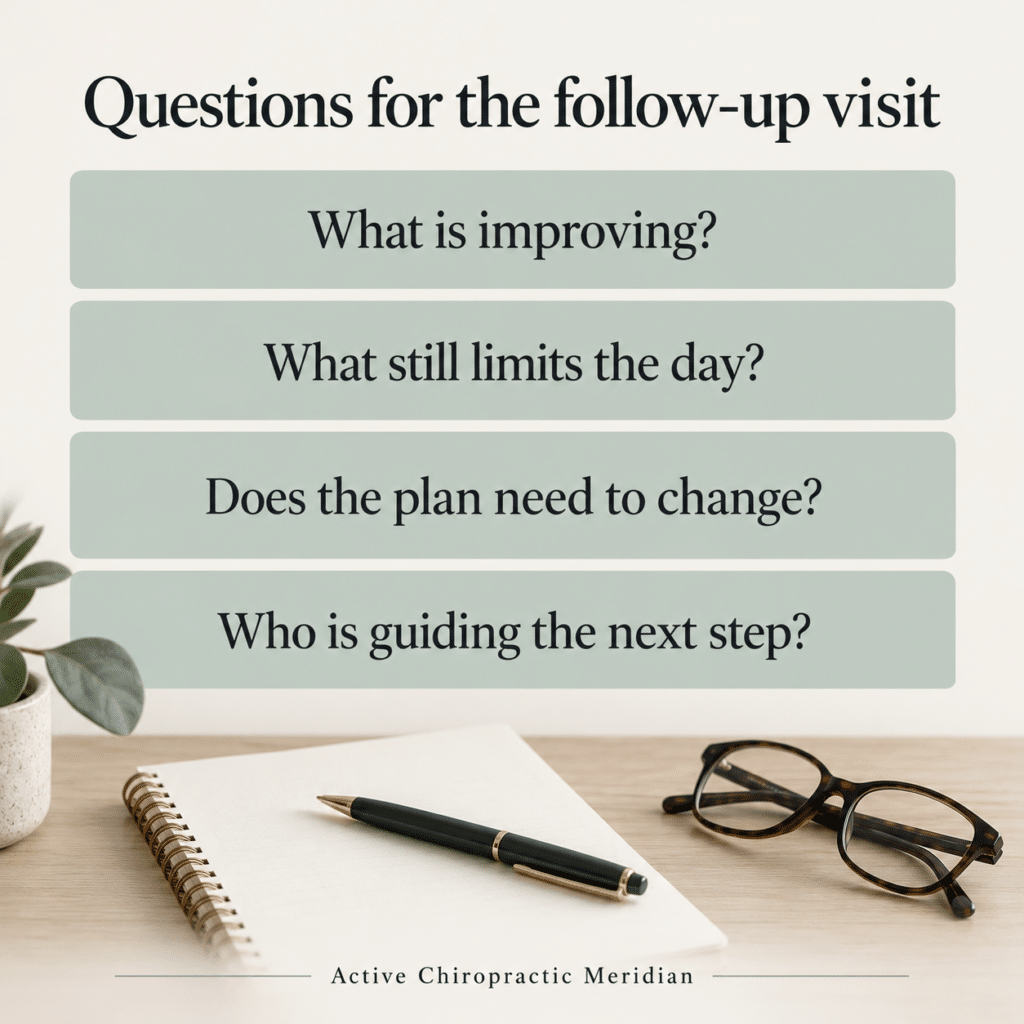
Questions for a concussion follow-up visit about improvement, daily limitations, the plan and who guides next steps.
Start With What Is Still Difficult
A useful next conversation can begin with a short description of the day: what is easier, what remains difficult and what has changed since the last visit. Bring the instructions already provided and ask whether the plan needs to be adjusted.
For ongoing concussion symptoms, contact the healthcare provider managing the injury. If you also have a musculoskeletal concern and want to ask whether an evaluation at Active Chiropractic Meridian may be appropriate, call 208-593-2001. Tell the office about the concussion and any current restrictions when arranging the appointment.
I want patients to understand their options and the reason behind a recommendation. Sometimes the right next step is another provider. That is part of giving an honest answer.
For a separate musculoskeletal concern, see sports injury evaluation in Meridian.
FAQs
Does ongoing brain fog mean the concussion caused permanent damage?
Ongoing brain fog alone cannot establish that. Persistent symptoms deserve follow-up so the healthcare provider can reassess the situation and consider relevant contributors or referrals. A blog cannot determine the cause, predict recovery or rule out a more serious problem. Seek urgent care for danger signs or significant deterioration.
Should my child stay out of school until every symptom is gone?
Not necessarily. CDC guidance supports an early return to school with appropriate symptom-based adjustments for many children. The healthcare provider and school should help determine the plan. Returning to class does not mean the athlete has clearance for contact sports or should ignore worsening symptoms.
Can we skip a return-to-play step if the athlete feels normal?
Follow the treating provider’s progression rather than skipping steps independently. Feeling comfortable at rest does not show how the athlete will respond to greater demands. CDC recommends a supervised progression, with monitoring for symptoms at each stage and provider contact if symptoms return.
Can chiropractic care replace medical concussion follow-up?
No. Suspected and ongoing concussion symptoms require appropriate medical evaluation and management. Any care for an accompanying musculoskeletal concern should be considered in that context. This article does not recommend a chiropractic treatment for the brain injury or provide clearance to return to sport.
Dr. Anthony Cutting at Active Chiropractic Meridian.
About Dr. Anthony Cutting
Dr. Anthony Cutting owns and provides care at Active Chiropractic Meridian in Meridian, Idaho. His approach emphasizes listening, clear explanations, individualized recommendations and the function each patient wants to regain. He recommends another provider when that is the more appropriate next step. This educational article does not represent a concussion diagnosis or individualized treatment plan.
Sources
- CDC HEADS UP: Signs and Symptoms of Concussion
- CDC HEADS UP: Responding to a Sports-related Concussion
- CDC HEADS UP: What to Do After a Concussion
- CDC HEADS UP: Returning to School After a Concussion
- CDC HEADS UP: Returning to Sports
- British Journal of Sports Medicine: Amsterdam International Consensus Statement on Concussion in Sport