
A Stiff Shoulder And A Weak Shoulder Are Not The Same Thing
Useful distinction? Yes.
Enough to diagnose yourself from a blog post? No.
Shoulders are good at being confusing. Two people can point to the exact same spot and have different diagnoses. That is why I care less about the sentence, “It hurts right here,” and more about what the shoulder can and cannot actually do.

Frozen Shoulder Usually Takes Motion Away In More Than One Direction
The American Academy of Orthopaedic Surgeons describes one of the hallmark findings as loss of both:
- Active range of motion: how far you can move the arm yourself
- Passive range of motion: how far the shoulder can be moved for you during an examination
That difference matters.
People often tell me things like, “I cannot reach behind my back anymore,” or “I cannot get my arm overhead.” Getting dressed becomes annoying. Reaching for a seat belt becomes awkward. Putting something on a high shelf turns into a whole-body maneuver.
Frozen shoulder usually develops gradually and can take time to improve. AAOS describes freezing, frozen and thawing stages and lists physical therapy focused on shoulder flexibility as a primary treatment recommendation, with other medical options considered depending on the individual situation.
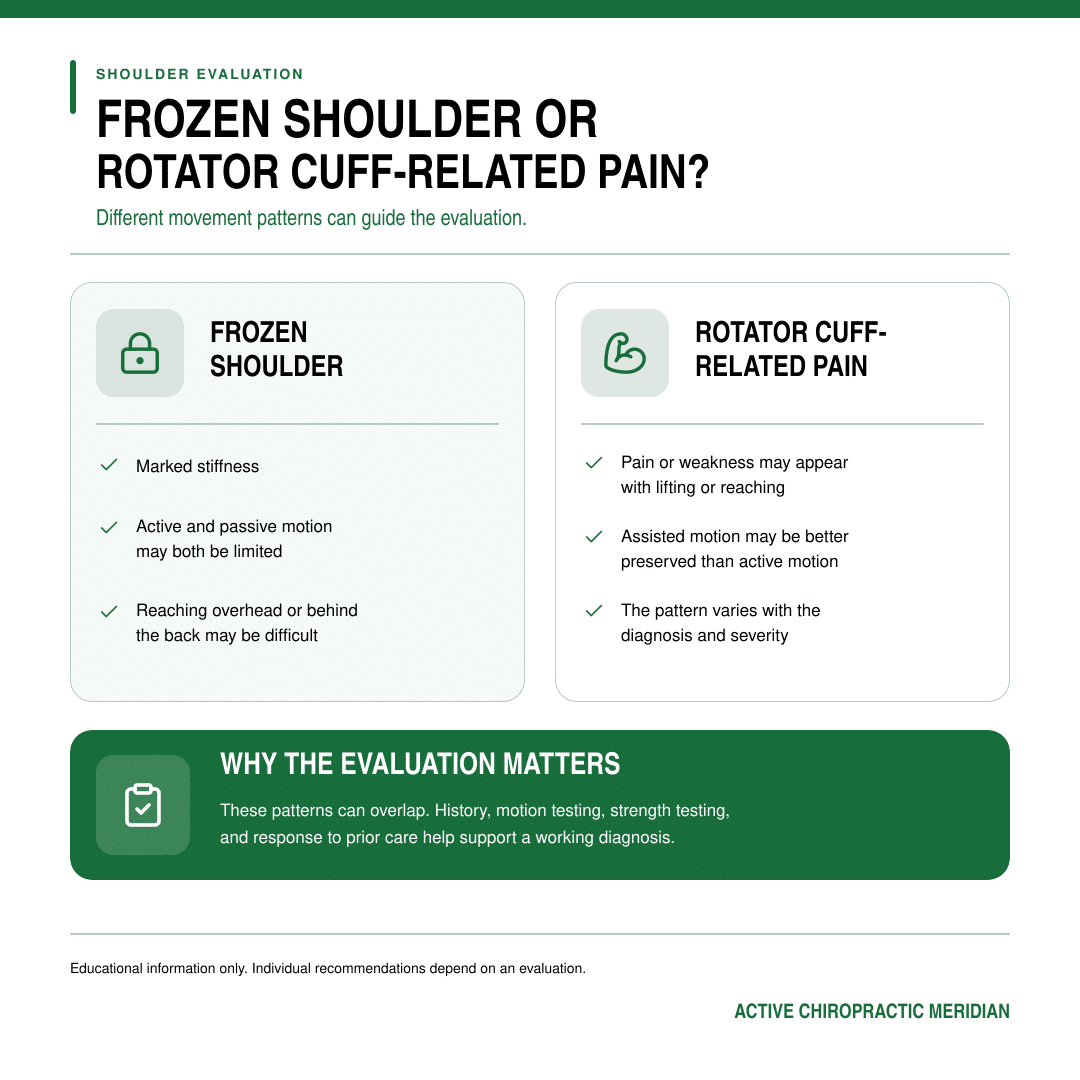
Rotator Cuff Problems Often Show Up When The Shoulder Has To Work
When there is a rotator cuff problem, the shoulder may still move, but certain movements hurt, feel weak, or simply do not have the same control they used to. Reaching overhead. Lifting something away from your body. Lowering the arm. Sleeping on that side. Pressing or pulling in the gym.
Rotator cuff problems can include tendinopathy as well as partial or full-thickness tears, and one symptom does not tell me which one is present.
Strength testing is one piece I pay close attention to. The 2025 AAOS rotator cuff guideline also supports using a combination of examination tests because no single test gives you the whole answer.
The Comparison I Find Most Useful
| Question | Frozen shoulder | Rotator cuff problem |
|---|---|---|
| How does motion tend to behave? | Both active and passive motion are commonly restricted. | Active movement may be painful or weak; passive motion may be less restricted, depending on the condition. |
| What do patients often notice? | Progressive stiffness, trouble reaching overhead or behind the back. | Pain or weakness with lifting, reaching, rotation or certain loaded movements. |
| Does one symptom diagnose it? | No. | No. |
| Can imaging help? | Sometimes, mainly to rule out other problems or when another diagnosis is suspected. | Yes, when the history and examination suggest a tear and the result will help guide management. |
The table is useful for orientation, not self-diagnosis. Arthritis, pain referred from the neck and other shoulder conditions can blur the picture quickly.
Arthritis Can Look Like "Just A Stiff Shoulder" Too
So a stiff shoulder is not automatically frozen shoulder. I still have to put the person’s age, history, examination findings and, when appropriate, imaging together before I am comfortable with a working diagnosis.
Sometimes The Shoulder Is Not The Main Problem
Pain can be felt in the shoulder even when the neck is contributing. Numbness, tingling or weakness that travels into the arm or hand makes me pay even closer attention to that possibility.
If I only stare at the painful spot, I can miss useful information. That is why a shoulder evaluation may also include relevant neck and neurologic findings instead of assuming every painful shoulder starts in the shoulder itself.
Why The Diagnosis Changes What I Recommend
At Active Chiropractic Meridian, I base recommendations on the individual evaluation and the function you want back. Depending on the working diagnosis, that may include rehabilitation and movement-based care, chiropractic care, soft-tissue treatment, or another service available in our office. Shockwave Therapy or Class IV Laser may be considered for some diagnoses, but neither is an automatic choice for frozen shoulder or a rotator cuff tear.
And sometimes the best recommendation is not another treatment in my office. It may be imaging, medical management, another rehabilitation provider or an orthopedic consultation.
When A Shoulder Problem Needs Faster Medical Attention
A sudden traumatic loss of strength or function also deserves timely medical evaluation rather than assuming it is a routine overuse problem.
Start With What You Want Your Shoulder To Do Again
Can you reach behind your back to get dressed? Sleep on your side? Lift your grandchild? Swing a golf club? Play pickleball? Work overhead? Get back to strength training without second-guessing every rep?
That is the part I want to understand early.
If shoulder stiffness, weakness or pain is limiting normal activities, call 208-593-2001 to schedule an evaluation with me at Active Chiropractic Meridian in Meridian, Idaho. If you already have imaging or a previous diagnosis, bring it. I want to compare what the image says with what your shoulder is actually doing now.
FAQs
How can you tell frozen shoulder from a rotator cuff problem?
Can frozen shoulder be diagnosed without an MRI?
If I can move my arm passively, does that rule out frozen shoulder?
Does a rotator cuff tear always require surgery?

Dr. Anthony Cutting owns and provides care at Active Chiropractic Meridian in Meridian, Idaho. He evaluates musculoskeletal concerns with an emphasis on clear explanations, individualized recommendations, realistic expectations and the function each patient wants to regain. Depending on the working diagnosis and individual evaluation, care may include chiropractic care, rehabilitation and movement-based care, soft-tissue treatment, Shockwave Therapy or Class IV Laser. When another provider or surgical evaluation is the more appropriate next step, he recommends it.
Sources
- American Academy of Orthopaedic Surgeons, Frozen Shoulder: https://orthoinfo.aaos.org/diseases–conditions/frozen-shoulder/
- American Academy of Orthopaedic Surgeons, Management of Rotator Cuff Injuries: Evidence-Based Clinical Practice Guideline, August 18, 2025: https://www.aaos.org/globalassets/quality-and-practice-resources/rotator-cuff/rotator-cuff-2025/rotator-cuff-cpg.pdf
- American College of Radiology, ACR Appropriateness Criteria: Chronic Shoulder Pain, revised 2022: https://acsearch.acr.org/docs/3101482/narrative/
- Mayo Clinic, Shoulder pain: When to see a doctor: https://www.mayoclinic.org/symptoms/shoulder-pain/basics/when-to-see-doctor/sym-20050696